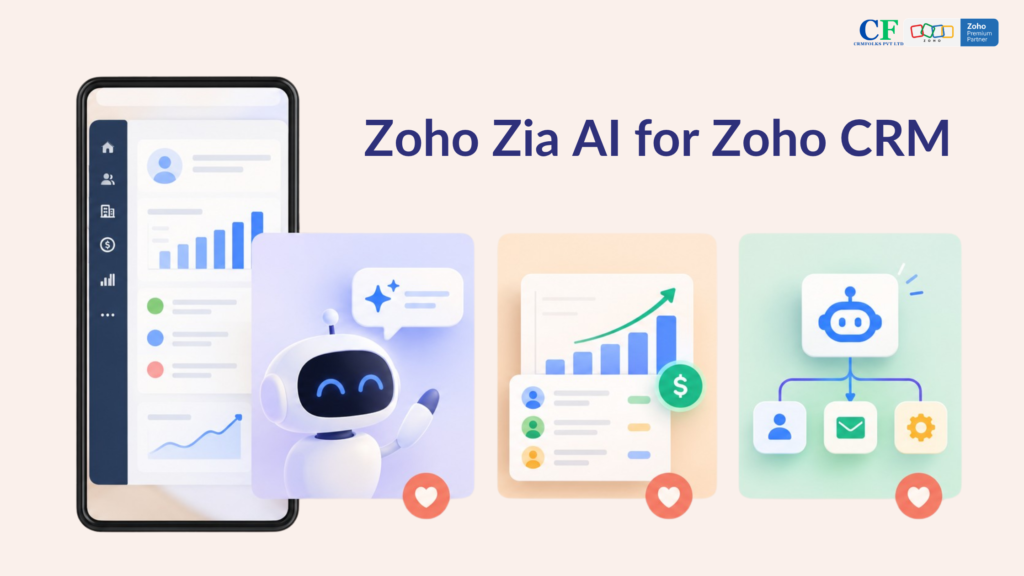
Discover how Zoho Zia brings AI-powered intelligence and automation to Zoho CRM, helping businesses improve lead management, sales productivity, customer engagement, and everyday CRM processes.
Businesses today need more than a CRM that simply stores customer information. Sales teams want faster insights, smarter automation, and less time spent on repetitive tasks.
This is where Zoho Zia comes in.
Zia is Zoho’s AI-powered assistant for Zoho CRM. It helps businesses analyze CRM data, automate tasks, generate content, identify opportunities, and make smarter decisions.
In this guide, we’ll look at how Zoho CRM AI, Zia, and automation can work together to create a more intelligent CRM experience.
What Is Zoho Zia?
Zoho Zia is an AI-powered assistant built into Zoho CRM.
It uses CRM data to provide predictions, recommendations, insights, and AI assistance for sales and customer management activities.
Depending on the features available in your Zoho CRM setup, Zia can help with:
- Lead and deal analysis
- AI-powered predictions
- Lead scoring
- Workflow suggestions
- Email and content generation
- CRM data insights
- Recommendations
- Natural-language queries
- AI-powered agents
Instead of manually analyzing every CRM record, users can use Zia to find useful information and take action faster.
How Does Zia Work With Zoho CRM?
Zoho CRM already contains valuable information about your leads, contacts, accounts, deals, activities, and customers.
Zia adds an intelligence layer to this information.
For example, instead of manually checking every deal in the pipeline, sales teams can use AI-powered insights to identify important opportunities and areas that may require attention.
This creates a simple combination:
CRM Data + AI + Automation = Smarter CRM Processes
Key Zoho Zia Features
- AI-Powered Lead Scoring
Sales teams often have hundreds or thousands of leads but limited time to follow up with all of them.
Zia Scores can help businesses prioritize records based on available CRM data and configured scoring models.
This allows sales representatives to focus their attention on leads that show stronger signals instead of treating every lead equally.
- Sales Predictions
Zia can analyze CRM data to provide predictions about sales-related outcomes.
Sales managers can use these insights to better understand their pipeline and identify deals that may require attention.
AI predictions should be used as decision-support information rather than guaranteed outcomes, but they can reduce the amount of manual analysis required by sales teams.
- Workflow Suggestions
Businesses often perform the same CRM activities repeatedly.
Zia can identify recurring activities and suggest workflows that may help automate them.
For example, repetitive actions such as assigning tasks, sending notifications, or updating records can potentially be converted into automated CRM processes.
This helps businesses discover automation opportunities that may otherwise be missed.
- AI-Generated Content
Sales representatives spend considerable time creating emails and other customer communications.
Zia’s generative AI capabilities can help users create, summarize, and refine CRM-related content.
Instead of starting an email from scratch, a salesperson can use available customer and CRM information to create a more relevant message and then review it before sending.
- Ask Zia
With natural-language interaction, users can ask questions about their CRM data without manually navigating through multiple screens.
For example:
- Which deals are closing this month?
- Which leads need follow-up?
- Show me my open opportunities.
- How do I create a workflow?
This makes CRM information easier to access for everyday users.
- AI Agents
AI automation is moving beyond simple trigger-based workflows.
Zia Agents can support more advanced tasks by using CRM information and configured tools and permissions.
Depending on the use case, AI agents can support processes such as lead qualification, sales assistance, and other CRM activities.
This creates an opportunity for businesses to move from simple automation toward more intelligent, task-oriented processes.
Zoho CRM Automation vs. AI Automation
Traditional CRM automation is still important.
Workflow rules, assignment rules, approvals, blueprints, and other automation tools are useful when a business process follows a clearly defined set of rules.
AI adds another layer by helping businesses analyze information, identify patterns, make recommendations, and generate content.
For example:
Traditional automation:
New lead → Check lead source → Assign salesperson
AI-powered process:
New lead → Analyze available information → Score lead → Prioritize → Trigger appropriate action
The best CRM strategy may combine both approaches rather than replacing traditional automation with AI.
Why CRM Data Quality Matters
AI is only as useful as the information available to it.
Poor CRM data can affect the usefulness of AI-generated insights and predictions.
Before implementing advanced Zoho CRM AI automation, businesses should review:
- Duplicate records
- Missing information
- Outdated customer data
- Incorrect fields
- Inconsistent sales stages
- Incomplete activity history
A clean and well-structured CRM gives AI better information to work with.
How a Zoho Partner Can Help
Implementing Zia is not only about switching on AI features.
A Zoho Partner can help businesses understand where AI and automation can provide practical value.
A Zoho CRM implementation partner can assist with:
- CRM setup and customization
- Data cleanup
- Workflow automation
- Zia configuration
- Custom functions and integrations
- AI automation strategy
- AI agent implementation
- Testing and optimization
The goal should not be to add AI to every CRM process.
Instead, businesses should identify repetitive or data-heavy processes where AI can provide a measurable benefit.
Zoho Zia Use Cases
Different teams can use Zia in different ways.
Sales
- Lead prioritization
- Lead scoring
- Deal analysis
- Follow-up assistance
- Email generation
Sales Managers
- Pipeline insights
- Sales predictions
- Performance analysis
- Deal prioritization
Customer Success
- Customer insights
- Retention-related recommendations
- Customer engagement analysis
Marketing
- Lead analysis
- Customer segmentation
- Engagement insights
The exact features available can depend on the Zoho CRM edition, configuration, permissions, and data requirements.
Is Zoho Zia Right for Your Business?
Zia can be particularly useful for businesses that already have structured CRM data and want to reduce manual work.
Consider exploring Zia if your team:
- Spends too much time analyzing leads
- Performs repetitive CRM tasks
- Manually prepares reports
- Struggles to prioritize opportunities
- Writes many similar sales emails
- Wants to introduce AI into its CRM processes
Start with a specific business problem rather than trying to automate everything at once.
For example:
Problem: Sales representatives don’t know which leads to prioritize.
Potential solution: AI-powered lead scoring.
Problem: Salespeople spend too much time writing emails.
Potential solution: AI-assisted content generation.
Problem: Employees repeatedly perform the same CRM tasks.
Potential solution: Workflow automation.
This makes your AI automation in Zoho CRM strategy more practical and measurable.
Final Thoughts
Zoho Zia brings artificial intelligence directly into Zoho CRM, helping businesses move beyond basic customer data management.
From lead scoring and sales predictions to workflow suggestions, content generation, natural-language queries, and AI agents, Zia can support different parts of the CRM process.
However, successful Zoho CRM AI automation starts with a clear business objective and reliable CRM data.
The right combination of Zoho CRM + Zia + automation can help businesses reduce repetitive work, improve productivity, and make better use of their customer data.
If you’re planning to implement Zoho Zia, AI automation, or advanced Zoho CRM automation, working with an experienced Zoho Partner can help you identify the right use cases and build a CRM system around your business requirements.