
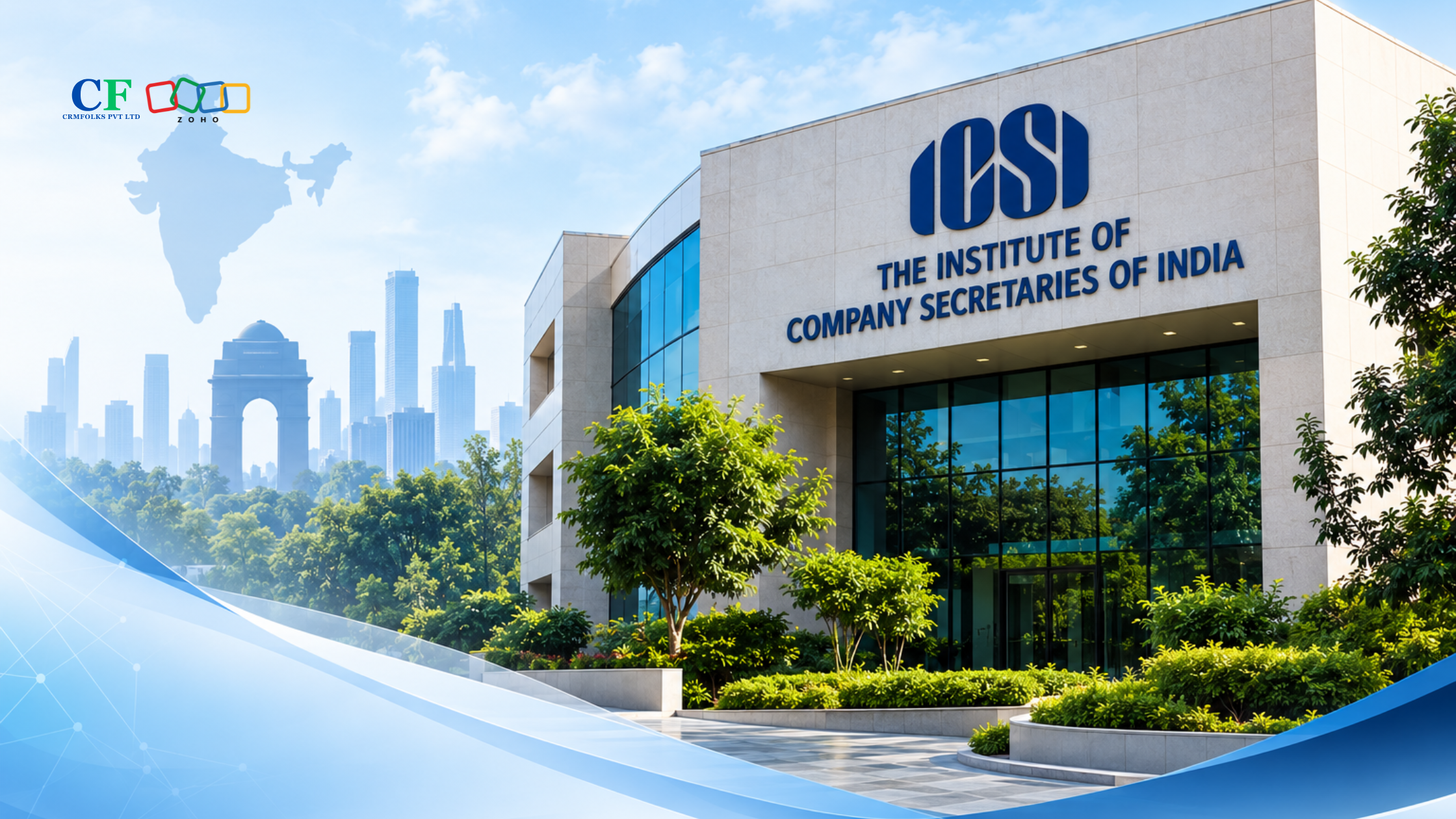
The Institute of Company Secretaries of India (ICSI) operates across a complex organizational and technology environment involving multiple departments, stakeholders, workflows, applications, and information systems.
CRMFolks conducted a Business Process Reengineering (BPR) and Enterprise Technology Assessment to evaluate how ICSI could move toward a more integrated, standardized, automated, scalable, and future-ready digital operating environment.
Rather than starting with software selection, the engagement focused first on understanding business processes, stakeholder requirements, applications, integrations, data, governance, security, reporting, and future technology needs.
Project Overview
ICSI required a structured approach to evaluate its existing processes and technology landscape and define a future-state enterprise architecture.
The assessment considered existing platforms including Oracle E-Business Suite, Microsoft SharePoint/COSMIC, CRAS, .NET applications, and other enterprise systems.
The project followed a BPR-first approach, ensuring that process redesign and business requirements guided technology decisions.
Project Objectives
The project focused on:
Core Challenges
Business Challenges
Process Fragmentation
ICSI’s processes had evolved across multiple departments and systems, creating manual handoffs, duplicated activities, and disconnected workflows.
Multiple Enterprise Systems
The technology environment included Oracle E-Business Suite, Microsoft SharePoint/COSMIC, CRAS, .NET applications, and other systems, making coordination and information flow more complex.
Manual Coordination
Processes involving reviews, approvals, transactions, communication, reporting, and audit could involve multiple systems and departments, increasing operational complexity.
Data Duplication
Different departments and applications could maintain separate versions of information, creating a need for stronger data ownership, governance, and migration planning.
Integration Requirements
The transformation required systems to communicate effectively rather than operating as isolated applications.
Modernization Requirements
ICSI needed to evaluate how existing systems could work alongside modern platforms, APIs, cloud technologies, analytics, mobile capabilities, and AI.
CRMFolks Solution
CRMFolks designed a BPR-first enterprise transformation approach, beginning with process assessment and stakeholder requirements before defining the future technology architecture.
The solution covered:
As-Is Process Assessment
CRMFolks assessed the existing environment to understand how work moved across departments, stakeholders, applications, and systems.
The assessment considered:
This provided a structured understanding of the existing operating environment before future-state processes were designed.
Stakeholder Requirement Assessment
Enterprise transformation requires more than an IT-focused assessment.
CRMFolks considered requirements across functional teams and directorates to distinguish actual business requirements from the limitations or behavior of existing applications.
This helped establish what processes needed to accomplish rather than simply reproducing how current systems worked.
Business Process Reengineering
The BPR approach focused on improving processes before implementing technology.
CRMFolks evaluated opportunities for:
The objective was to create simpler, measurable, scalable, and governable processes.
Enterprise Application & ERP Assessment
ICSI’s existing technology landscape included Oracle E-Business Suite R12.2.10, supporting Finance, HRMS, Payroll, Purchasing, Inventory, and Order Management.
Rather than assuming a complete replacement was necessary, CRMFolks evaluated how existing systems could continue serving appropriate functions within a modern enterprise architecture.
This approach supported a hybrid transformation strategy instead of a complete rip-and-replace model.
Zoho Platform Assessment
CRMFolks assessed the Zoho Platform against ICSI’s broader enterprise transformation requirements.
The assessment considered its potential role in:
The focus was on determining where Zoho could contribute within the wider enterprise architecture.
Hybrid Enterprise Architecture
The proposed architecture considered multiple technology layers working together.
Key Architecture Components
Zoho Platform
Configurable enterprise capabilities and workflow requirements.
React / Next.js
Modern portals and digital user experiences.
Node.js
Integration and business-services layer.
Oracle E-Business Suite
Continued financial system of record, subject to detailed fit-gap validation.
Enterprise AI
Future intelligent automation and decision-support opportunities.
This architecture followed the principle that transformation does not always require replacing existing technology.
API-First Integration
Integration was treated as a core part of the enterprise architecture.
The proposed API-first approach enables systems to exchange information programmatically while maintaining clear system responsibilities and boundaries.
This can reduce repeated data entry and improve information flow between established enterprise systems and modern digital platforms.
Data Migration & Governance
CRMFolks considered data migration alongside master-data governance.
Key areas included:
A strong data foundation is essential for reliable automation, analytics, and future AI initiatives.
Reporting & Enterprise Analytics
The assessment considered how reporting could move beyond individual application boundaries.
Instead of separate reports for individual departments, a connected enterprise architecture can provide leadership with broader operational visibility and support more consistent management reporting.
AI-Ready Enterprise Architecture
AI readiness was considered as part of the future technology landscape.
CRMFolks identified the importance of establishing:
The approach recognizes that effective enterprise AI depends on the quality of the processes, systems, and data supporting it.
Security, Governance & Accessibility
The assessment also considered:
These requirements were considered as part of the architecture rather than as post-implementation additions.
Implementation Roadmap
CRMFolks established a structured transformation methodology:
Discovery
↓
Process Reengineering
↓
Enterprise Architecture
↓
Functional & Technical Design
↓
Implementation Planning
↓
Development & Configuration
↓
Testing & UAT
↓
Rollout & Hypercare
↓
Continuous Improvement
This approach helps ensure that development follows clearly defined processes, responsibilities, and architectural principles.
Change Management & Training
Digital transformation extends beyond technology implementation.
The assessment included change-management and training considerations to support:
Business Outcomes
The engagement established a structured foundation for ICSI’s enterprise transformation.
Key Outcomes
Project Technology Stack
| Application / Technology | Role in the Project |
| Oracle E-Business Suite R12.2.10 | Enterprise ERP and financial system of record |
| Zoho Platform | Configurable enterprise capabilities |
| Microsoft SharePoint / COSMIC | Existing enterprise applications |
| .NET Applications | Existing custom applications |
| React / Next.js | Portal and digital user experiences |
| Node.js | Integration and business-services layer |
| APIs | Enterprise system integration |
| Cloud Technologies | Future digital infrastructure |
| Analytics | Enterprise reporting and decision intelligence |
| AI | Future intelligent automation |
Conclusion
The ICSI Business Process Reengineering and Enterprise Digital Transformation Assessment demonstrates the importance of putting business processes before technology implementation.
CRMFolks evaluated ICSI’s processes, stakeholder requirements, applications, integrations, data, governance, security, analytics, and future technology needs to establish a structured transformation framework.
The assessment provides a foundation for a more integrated, standardized, automated, scalable, and future-ready enterprise ecosystem.
For CRMFolks, the engagement demonstrates how BPR, enterprise architecture, Zoho expertise, integration, custom development, data strategy, analytics, and AI readiness can work together to support complex enterprise transformation.
Join 100+ companies using CRMFolks to streamline their operations with Zoho. Free consultation, no commitment.